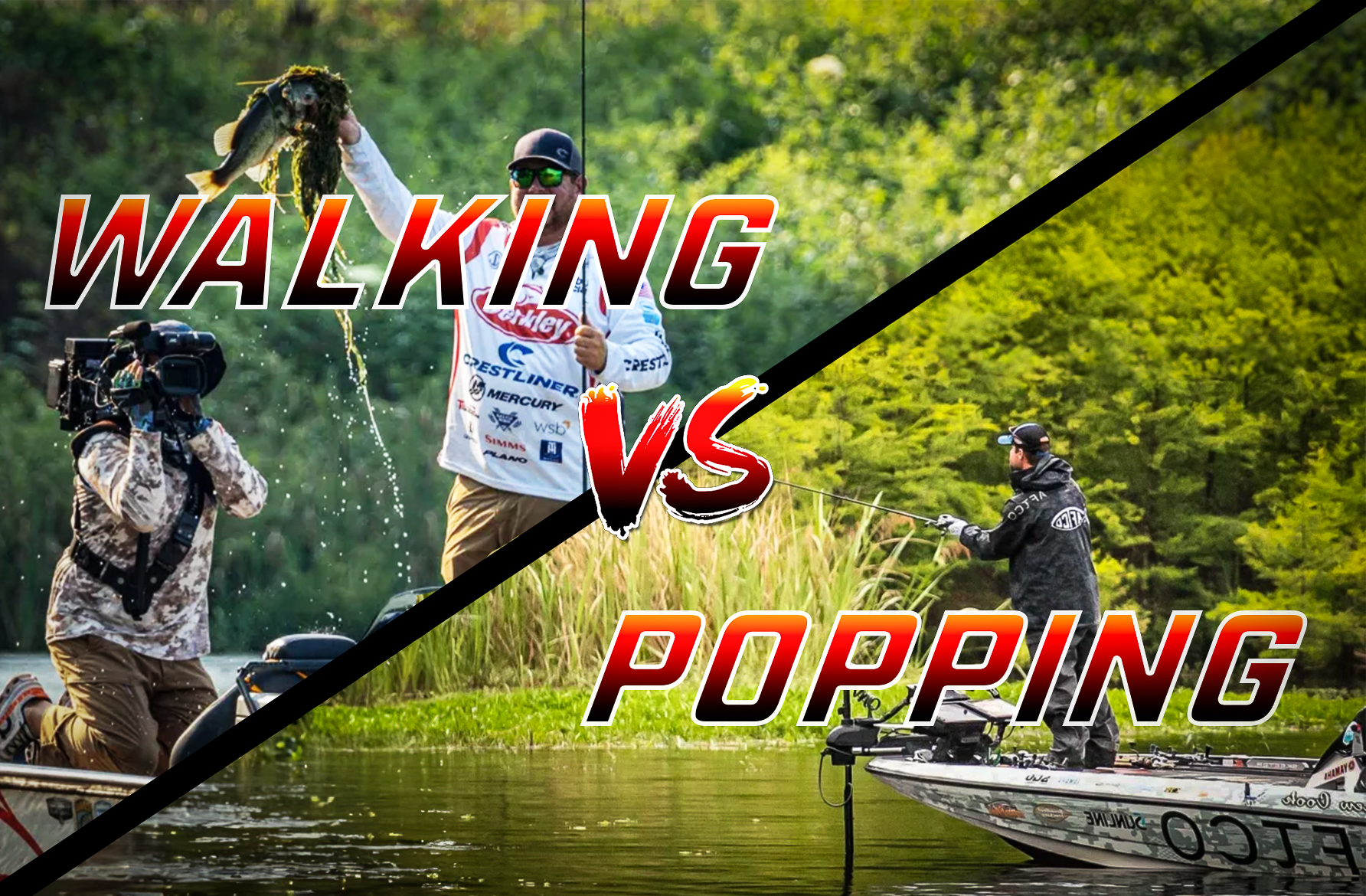
Who doesn’t love a good frog bite? The hollow-bodied frog has become one of the favorite topwater baits in the tacklebox for many anglers, especially those who live on grass lakes. The DeBAIT isn’t to throw a frog, but to decide which type of frog to throw — a walking frog or a popping frog.
John Cox and Drew Cook keep a frog on deck most times of the year, but each has a strong preference on which type of frog works best. Who’s right? You decide.
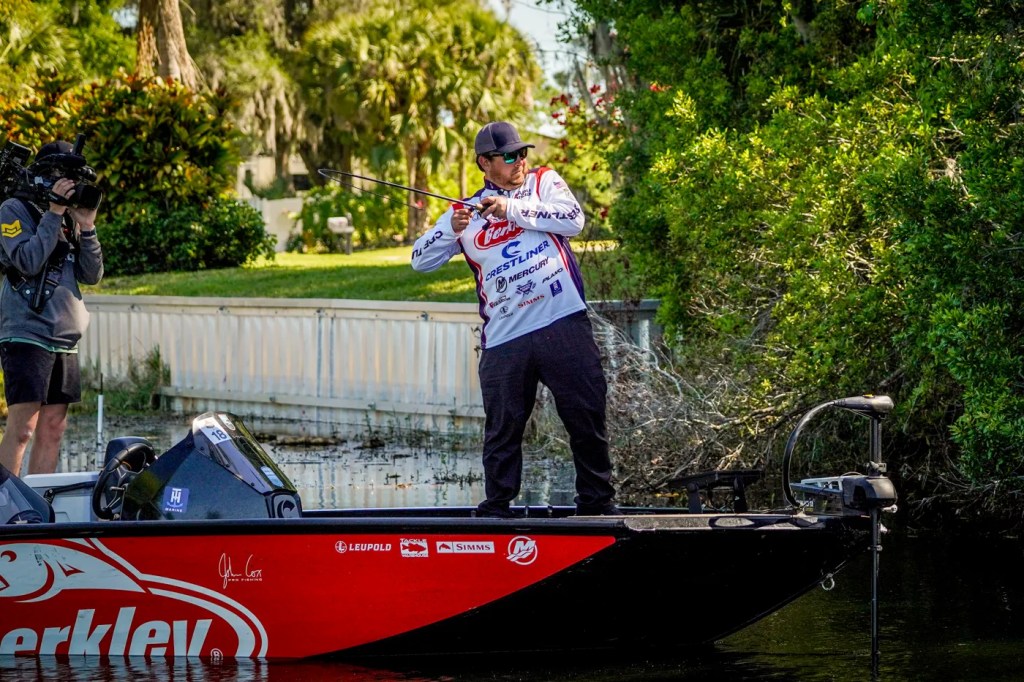
Walking frog
For most of his fishing life, John Cox didn’t know anything but a mat frog. But at the beginning of his frog throwing days, a frog was just a vessel to get to a flipping bite.
“I remember watching Dean Rojas catching them with a frog and thinking, ‘That is the coolest thing,’” he said. “But I didn’t really understand mat frog fishing for a while until I fished with different people. When I started throwing it, flipping the 1-ounce weight was so dominant. That’s what we were winning tournaments with. You could frog on certain days, but the window seemed smaller than the flipping bite.”
Now the DeBary, Fla., pro is known as one of the best frog fishermen on tour. The defining victory of his career, to this point, came at the 2016 Forrest Wood Cup at Wheeler Lake, where Cox threw a Jackall Iobee Frog, more of an open-water, walking frog.
As a Berkley pro, Cox now almost exclusively throws a Swamp Lord, notching a Top 10 with it in a return trip to Wheeler Lake during the 2024 Elite season. For Cox, the normal frog can be used in any type of cover, as well as in open water.
“I can throw it anywhere. I feel like in the really thick stuff, the popping frog doesn’t push down on the mat or slap the mat,” he said. “The normal frog just moves through that stuff a lot better. To me, it is a lot more versatile. The Swamp Lord is so good. It just draws bites. You can do everything with it.”
Speed is also an important part of the equation for the six-time Classic qualifier.
“I like to fish it fast, and everyone says I fish it too fast,” he explained. “Anytime I’m with anybody or if some guys come out to their dock, the first comment is, ‘Boy, you are fishing it way too fast.’ Which, maybe I am, but I do really well with it sometimes. But, it must work really well slowly too. I even went fishing with (Brandon) Lester, and he was like, ‘You’re working it too fast.’”
To make the frog walk even better, Cox will trim the legs to a point at a 45 degree angle so the Swamp Lord has less drag.
“It already has thinner legs,” he said. “So there is less resistance when you walk. You don’t really even have to trim them. I really just do it because I’ve done it with other frogs for so long.”
None of this is to say he won’t ever throw a popping frog. In fact, Berkley launched a popping version of the Swamp Lord that Cox experimented with in the offseason. What he’s found is, the popping frog shines in less than ideal frogging conditions.
“I never got into the popping frog thing until Berkley was like, ‘Hey, we’ve got a popping frog we are working on,’ and I was forced to throw it. I do see now with the popping, there are advantages.
“When I’ve got holes in the grass,” he continued, “I will get it in a hole and have it spit in the same place. When I want the frog to sit in the strike zone longer, that is when I go to the popping frog.”
Popping frog
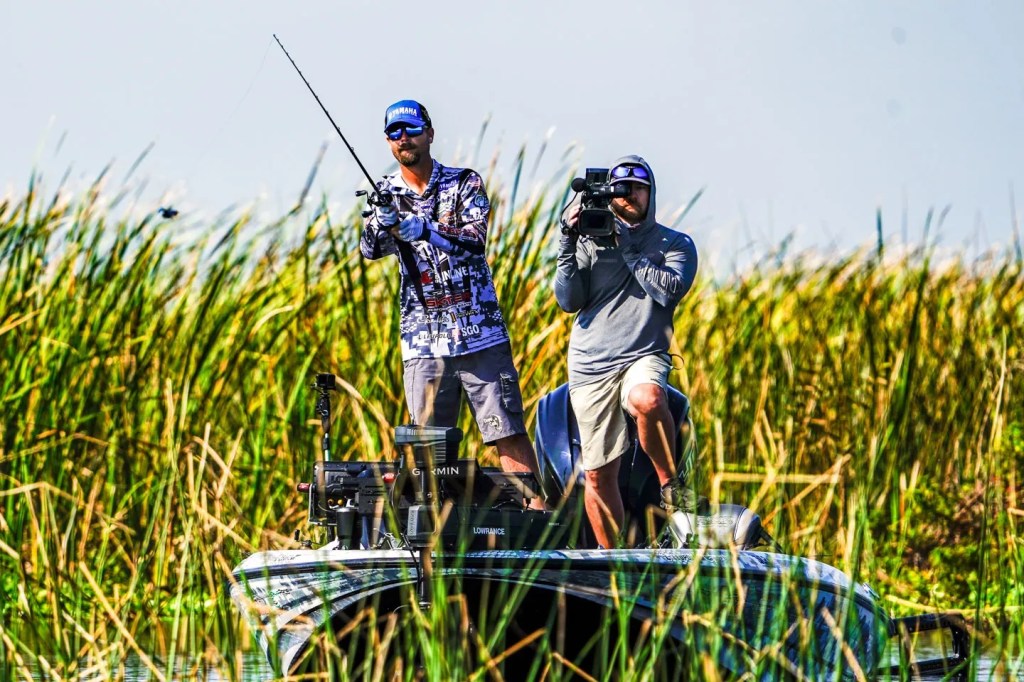
In a different section of the Sunshine State, Drew Cook has grown very comfortable throwing a popping frog. In fact, 95% of the time, he will throw the Spro Bronzeye popping frog over a regular frog.
With the cupped face, Cook believes the popping frog has more drawing power than a normal frog. It makes more of a disturbance on the surface and is also more stationary than a walking frog.
“It makes more commotion. You can move it more without moving it,” the 2022 Santee Cooper champion said. “When you pull it, that face stops it while creating a bunch of commotion. If you pull a regular frog just as hard, it would move further away. So the popping frog will stay in the strike zone, and I feel it will draw bass from further away.”
Cook honed his frog fishing skills on Lake Seminole and Lake Talquin, which feature several different types of vegetation. Talquin supports plenty of lily pad growth while Seminole has hydrilla beds and other grasses.
“It’s not super duper thick,” Cooks said. “A lot of the hydrilla, especially when I was growing up, would still have a little water over it. It was still topped out, but you could work it without feeling like you were throwing it in the front yard. I’ve always gravitated to that popping frog. I always wanted one tied on and there was no sense in having more than one frog tied on either.”
Outside of the winter months, and when the Bassmaster Elite Series travels to smallmouth country, Cook will have a popping frog rigged up and ready to go all year. Spring tends to provide the best action, starting in the prespawn and continuing into the beginning of summer.
“This year, I will 100% have a frog tied on until we go to St. Clair,” he said. “A lot of times during the actual spawn when they are locked on a bed, you want to leave the frog there for as long as possible and annoy them with it.”
The shad spawn also provides a unique opportunity for Cook. In some instances, he will cut the tails entirely off of his popping frog and replace them with feathers. At other times when he feels the bass are keying in on shad, he will add tinsel to the trails as well.
When the grass is super thick and cheesed out, that is when Cook will tie on a walking frog.