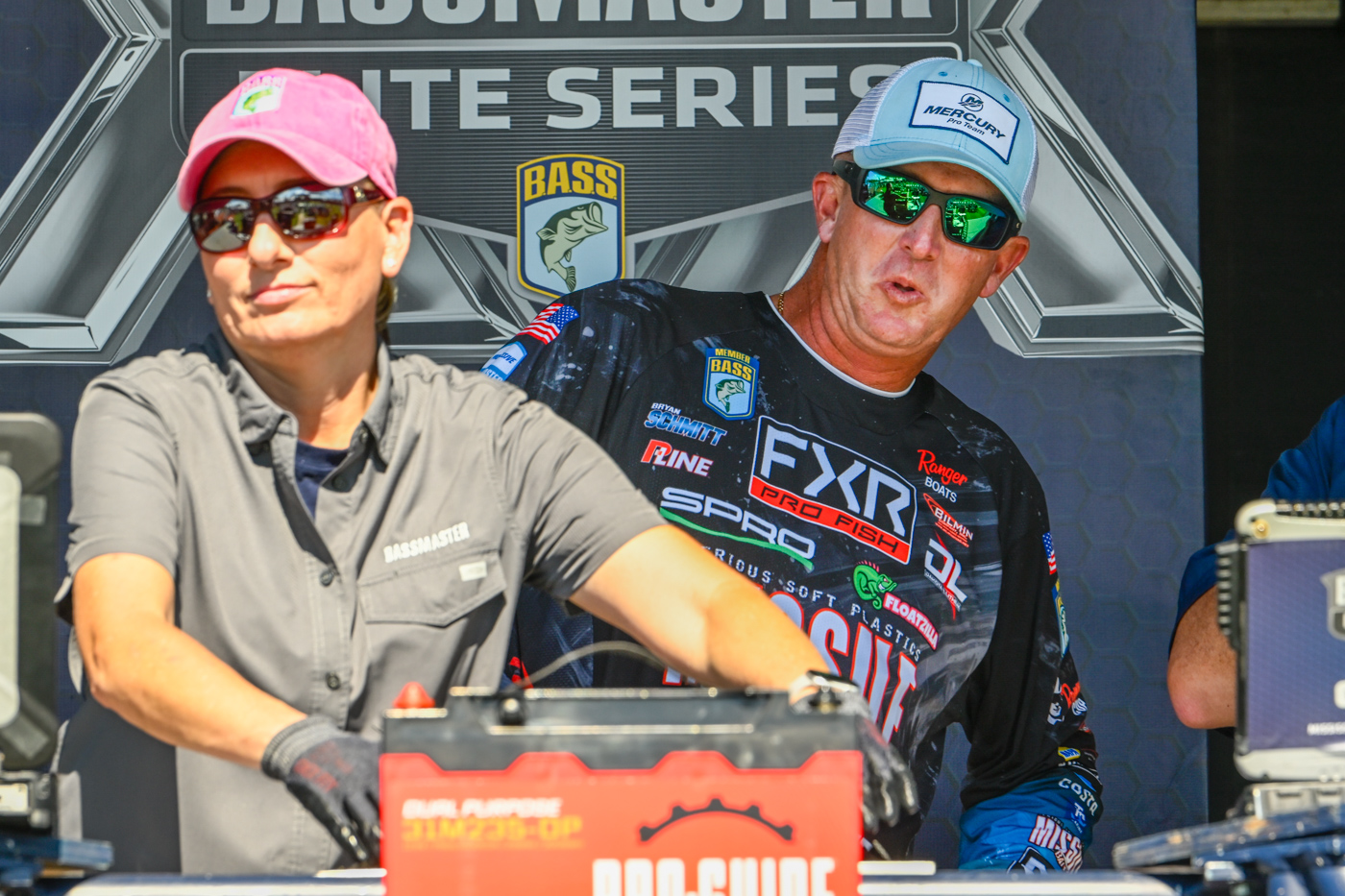
When Bryan Schmitt claimed the coveted blue trophy during the 2022 Elite event at the Mississippi River, he leveraged a particular depression where adjacent vegetation sent clean, filtered water across the low spot’s hard bottom.
Defining “no-brainer,” Schmitt gave that site a good look this week, but when asked of his findings, the Maryland pro held up the double goose eggs.
“Not a sign of life!” he exclaimed.
That lamentation bespoke the impacts of nature’s longterm and short-term shifting. Most recently, the first part of tournament week saw significant rains sending muddy runoff into the system.
The river’s eel grass and other vegetation, plus steady current flow eventually moderates the turbidity, but in the meantime, it’s a game of relocation.
“It’s different, for sure,” said Schmitt, who placed ninth on Day 1. “What’s cool about it is how the river changes. Sand bars move, grass changes and it’s about finding them every year.
“Bottom line, it’s never the same. Waypoints really don’t matter.”
That’s generally the case for river fishing, as the inherent dynamics of constantly flowing water regularly carve, shape and rearrange the moveable pieces. Fish are creatures of habit, but those habits directly correlate to habitat.
When habitat changes, fish change.
Mix and match
The Upper Mississippi holds healthy populations of largemouth and smallmouth bass. Both roam the entirety of tournament waters — pools 7, 8, and 9), but Day 1 leader Caleb Kuphall said he’s noticed some demographic shifting.
“The river has come up about a foot since the beginning of practice and there’s a lot more smallmouth biting now in (some) areas,” the Wisconsin pro said. “I’m catching twice as many as I did in practice.”
Kuphall only ended up weighing one smallmouth on Day 1 and that fish was his limit’s lightest. However, the rule of the region states that, with green ones and brown ones, you gotta go through the numbers to pick off the occasional big bite.
It’ll be interesting to see if smallmouth earn an increasingly larger presence for Kuphall and others.
Necessary adjustments
In most fishing scenarios, the majority of the fish are found in a relatively small percentage of the fishable waters. In this tournament’s habitat-rich waters, it may look like you could catch a fish anywhere your bait falls, but reality tells a different tale.
“This week, the fish are in such small areas,” Schmitt said. “You could be off by 5 feet and (you’ll miss them) by a lot. The current positions them; you can’t just go fishing and catch fish. They’re right there and that’s it.”
Schmitt’s extensive background on tidal fisheries like the Potomac River has helped him piece together the Mississippi’s puzzle. In his view, it all comes down to hydro dynamics.
“You have to understand current and how it positions fish,” Schmitt said. “It could be on the front side of something, the back side of something; something that makes an eddy. That’s the key.”
The clear solution
The other critical component is water clarity. Clean water is hard to find after a big rain event and dingy tendrils of the main muddy flow display frustrating reach.
Case in point: Pat Schlapper, who placed fourth on Day 1, just 7 ounces off the lead, explored one of his more promising areas and found the rising water allowed him to reach an inner sanctum. Unfortunately, the mud had beat him to it.
Schmitt said this will be a common story throughout the tournament’s conclusion, but mud is not everywhere, and where it is not, anglers may find a motherlode of potential.
“A couple of things went bye-bye because of the mud, but that makes the fish seek the available clean water,” he said. “Some guys are gonna get better as this week goes on.”
Schmitt found a Day 1 limit of 17 pounds, 3 ounces. He knows he has a lot of work to do before even thinking about lifting another blue trophy, but given the scenario, he knows he’s off to a promising start.
“Man, I’m happy!” Schmitt grinned. “I’m tickled. Tickled.”