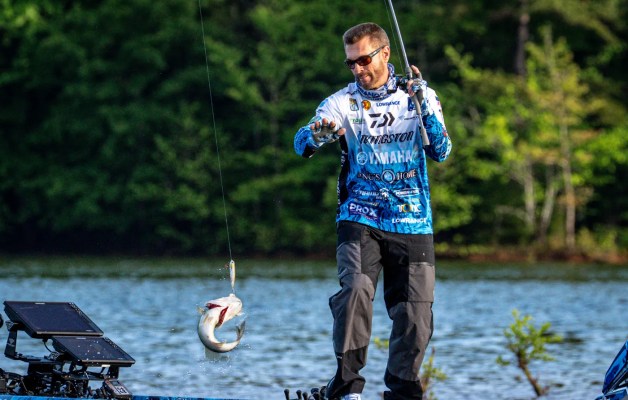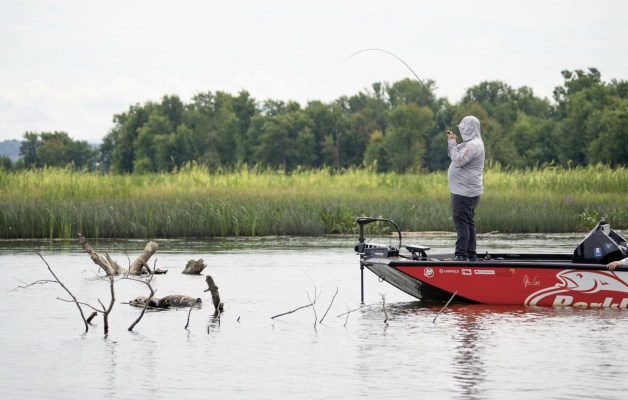


After the Bassmaster Elite Series tournament at Lake St. Clair, I spent five days in Iowa working with Berkley and filming content for them and some of my other sponsors. While fishing for smallmouth in Iowa, I confirmed something I learned at St. Clair — there are times when a micro jig outperforms a drop shot.
A drop shot is number one on northern smallmouth waters. But I caught two to three times as many smallies with a micro jig than with a drop shot at St. Clair and in Iowa.
When smallmouth feed on forage above the bottom, you can’t beat a drop shot and a swimming minnow bait for tempting bites up in the water column.
But there are times when the smallmouth focus on bottom forage like gobies, crayfish, larvae and nymphs. It’s unbelievable how many more fish you catch with a micro jig when that happens. If I didn’t see it with my own eyes, I wouldn’t have believed it.
Smallmouth also hug the bottom when there’s current. Even large bodies of water like St. Clair and the Great Lakes can have a substantial current. The smallmouth get behind a dip or rise in the bottom or a boulder where they can chill out of the flow and wait in ambush.
Ten years ago, you never heard much about micro jigs. Now many companies offer them. I worked with Missile Baits to design one of the first. We named it, simply, Ike’s Micro Jig.
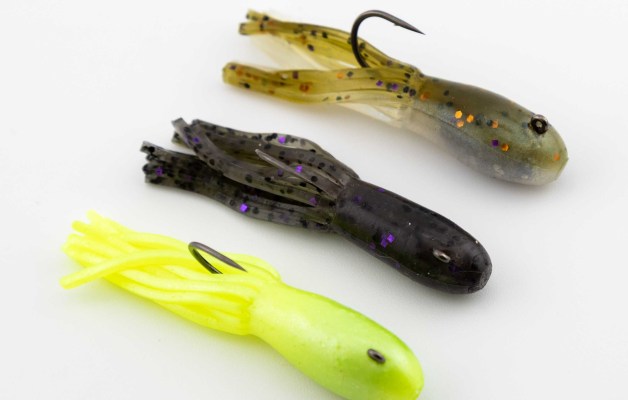
It has a pill-shaped head similar to a Ned jig, a weed guard and a sparse skirt that has thin strands. The hook is small but stout and has a 90-degree line tie. It comes in 1/16- through 1/4-ounce sizes.
I thread a small, low-action trailer onto the hook. I cut Berkley’s 3 1/2-inch Water Bugin half and dress the hook with the rear section of that bait. I do the same thing with Berkley’s 3 1/2-inch Maxscent Flat Worm. I cut the Flat Worm’s bulbous tail in half with scissors to make it look like a craw.
I keep it simple with colors — green pumpkin, watermelon, P&J and I’ll throw in a whitish shad pattern.
The beauty of the Micro Jig is it’s one of the easiest baits you can throw. I fish it with the same tackle I use for the Ned rig, a 6-6 to 7-foot medium to medium-heavy spinning rod matched with 10-pound Berkley Forward Braid knotted to a 14- to 18-inch, 6- to 10-pound Berkley 100% Fluorocarbon leader.
I cast just past where I think the smallmouth are and let the Micro Jig sink to the bottom. Then I very slowly and methodically pull the jig over the bottom from 3 to 12 o’clock. I hold the rod in my right hand and angle it over my left shoulder. That gives me a few more feet to swing the rod back when I set the hook, as opposed to lifting the rod toward my face.
Just, pull, pull, pull along the bottom until you feel the jig hit an object, like the sand grass at St. Clair, chunk rock, a boulder or whatever. Then immediately stop retrieving and let the jig sit in place.
Even though the jig isn’t moving, that thin skirt continues to breath. I’m 100% certain this is why the Micro Jig is so effective. I let it sit there for five seconds or so, which gives the bass time to smell the Maxscent trailer. Bass can’t resist the combination of the subtle, lifelike motion and scent.
As much as I don’t love forward-facing sonar, it shows me when the smallmouth lie with their bellies tight to the bottom. Although there isn’t any separation between the bass and the bottom, I can see what I call “worming.” It looks kind of like an old break-dancing move. The bottom appears to be worming along slightly up and down.
You can learn more about how I fish Ike’s Micro Jig and other baits at www.mikeiaconelli.com or www.youtube.com/c/goingike.