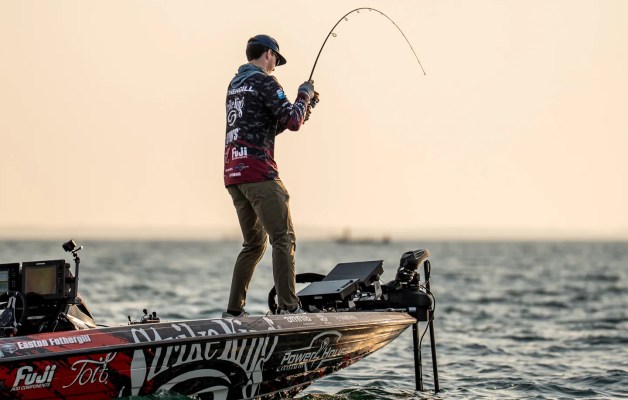


I recently fished a major tournament in September on the Potomac River that drew more than 100 anglers. I’m pleased with my 12th-place finish. I relied on several components to help me locate the productive area I fished.
The Potomac is a tidal fishery, but many of these components also apply to September river fishing in general.
Every September, bass fishing gets tricky on tidal rivers up and down the East Coast — from the St. Johns north to the Connecticut. Shorter days, cooler nights, dying vegetation and other factors cause bass and baitfish to reposition and relocate.
Whenever I fish a river tournament at this time of year, I know it’s going to be a challenge. I welcome that challenge.
If you can catch 12 to 15 pounds a day on the Potomac in September, you have a shot at winning. This fishery typically yields heavier limits at other times of the year.
When I’m searching for bass on a river, the first step is finding food. The most obvious way to do this is with your eyes. You can often see bait flicking on the surface or birds circling and diving on baitfish.
You can also do this with your electronics. When I scan a flat with my Lowrance graph, it reveals whether schools of baitfish are present.
Many anglers miss another way to find bass forage, which is to listen for it. That’s how I found my primary area for the Potomac tournament. When I checked that area in practice, I could hear continuous popping and sucking sounds of panfish feeding under matted grass. I couldn’t see the baitfish, but my ears confirmed they were there.
In September, there are massive areas of bad water in river systems. You don’t need to be a scientist or a biologist with a fisheries degree to know what bad water looks and smells like.
The water may appear stagnant. If dying vegetation is present, it looks almost fuzzy and the water stinks.
Good water is stained to clear. It looks healthy and doesn’t have a foul odor. There are also signs of life, such as minnows and crayfish.
If I see goldfish, I know I’ve hit pay dirt in terms of water quality. I hate to give away this tip, but I feel obligated. Some people release goldfish into rivers when they dump the contents of their aquariums. Goldfish can’t tolerate bad water.
Finding an area that has a gentle current flow has become extremely important to me when I fish a river system in September. I avoid dead, calm water, as well as places where the current is ripping.
Calm, still, protected water is what you want in wintertime and during the spawn. In the heat of the summer, especially in July and August, a heavy current flow attracts bass.
But in September, which is a transition phase, bass seek places that have a steady, gentle current. A piece of drifting grass can tip you off to this. In the area I fished during the tournament, the current made the milfoil lean over.
The oldest debate about bass fishing on a tidal river is whether you should run the tides or camp and fish through the tides. If I’m fishing grass in September, my rule of thumb is to stay put, provided the area has bait, good water and a gentle current.
There will be little bite windows throughout the day, and they don’t just open on the lowest tide. My most productive windows during the Potomac tournament were on high tides. That happens a lot in September.
On the other hand, hard cover can be just as productive as grass in September. When milfoil, hydrilla, eelgrass and other aquatic vegetation die in September, the bass respond by moving out of the grass and relating to hard over.
When the bass are on hard cover, I do run the tides. Wherever I stop, I want to be fishing during the last couple of hours of an outgoing tide and the first hour of an incoming tide.
With the technology we have today, you can check tide charts on your smartphone or a tablet. I can even check tide charts on my Lowrance graph.
Whenever I fish a river in September, all these strategies pay off for me big time.
You can learn more about how I fish rivers, as well as other bass tactics, at www.mikeiaconelli.com or www.youtube.com/c/goingike.