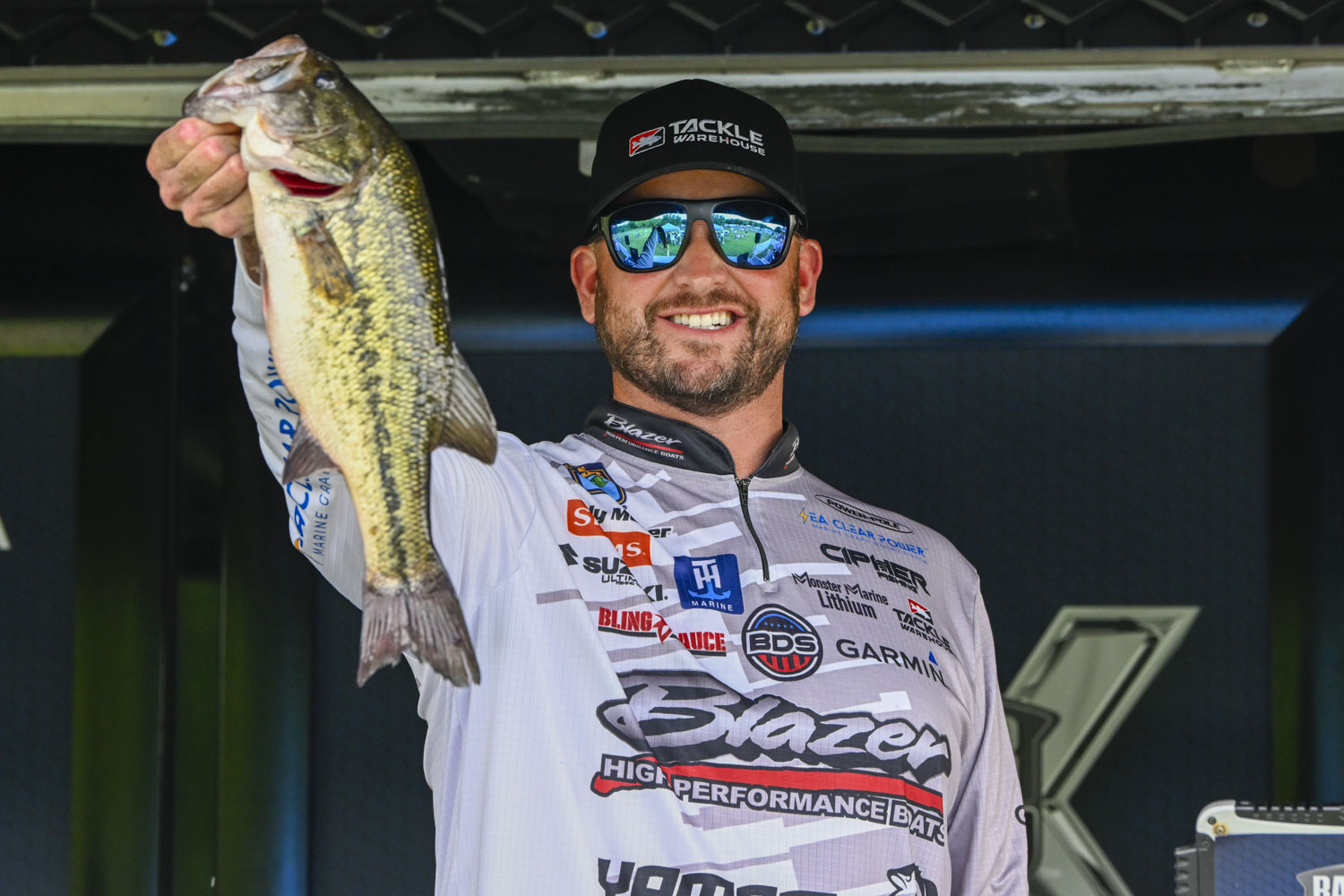

Going into the Elite Series tournament at Lake Tenkiller, Oklahoma, I was coming off two lackluster finishes in Texas. When you have a bad tournament — in this case, two of them — the best way to shake it off is to fish another tournament as soon as possible.
If I did poorly at Tenkiller, I’d have to stew about that for nearly two months until the next event at Lake St. Clair. Even worse, a subpar performance could drop me from 27th place in the Progressive Bassmaster Angler of the Year standings to below the cutline for the 2026 Bassmaster Classic.
I had never been to Tenkiller but felt positive about fishing there. It’s a clear-water reservoir and has a mix of largemouth, smallmouth and spotted bass. I like clear water and expected Tenkiller to be similar to the Table Rock and Beaver lakes I’ve fished for years.
I also believed forward-facing sonar would be a big player at Tenkiller, as it has been all year. For the first day and a half of practice, I fished the lower end of the lake with forward-facing sonar and struggled to get bit.
There had been a ton of rain before I got to Tenkiller, and the water had been as much as 5 feet above full pool. It had fallen to a foot above full pool by the first practice day and was still dropping.
Then the rain started coming down in torrents. By the second day of practice, the lake was 7 feet above full pool and had flooded countless bushes, trees and other cover along the shoreline.
At that point, I still believed forward-facing sonar would be the way to win. But I couldn’t resist getting into that flooded cover and employing some old-school fishing tactics. I caught a 3 1/2-pound largemouth in the first pocket I fished and that was all she wrote.
I decided right then and there that win, lose or draw, I was going to turn off my graphs and have some fun flipping, frogging and winding a spinnerbait. And, boy, did I ever.
I landed at least 20 of the 30 or so bites on all three of the competition days I fished. The bass that got off took full advantage of the heavy cover. I finished 36th, and I’m still holding at 27th place in the AOY standings.
A key adjustment: I had to fish new areas every day because the water level started dropping during the tournament.
In practice and early in the tournament, the steeper banks were more productive. That’s because the cover on a steep bank is always at the water’s edge. The bass can’t get too far behind it for you to reach them. These places got the most fishing pressure, which made the bass harder to come by.
During practice, I fished some bushes in flatter pockets where the bass could swim back into trees and other cover I couldn’t get to. I never got a bite there. But I remembered something I learned from Greg Hackney and marked those places on my graph.
As the water dropped, it pulled the bass in those flat pockets out to the cover I had fished in practice without success. I returned to those places during the tournament and had the bass to myself. Thanks, Greg.
Just about everyone who did well at Tenkiller took advantage of old-school, shallow-water bass fishing. Everybody was smiling because we were having so much fun. It felt good to wield casting outfits filled with 20-pound test and to leave the spinning outfits in the rod locker.
The event lifted my spirits and gave me a load of momentum to carry into the final two Elite Series events of the season.